
Sweeping, inspection and chimney repair for Winter Garden homes, old brick and new builds alike.
A west Orange County city of about 48,000 people just south of Lake Apopka, where the typical home was built in 2004 and about 65 percent date from 2000 or later.
- Write to usThe form never closes
- We phone backAnd pick a day with you
- Based in Winter GardenWest Orange County, Florida
Four ways we can help, from the roofline to the hearth.
 Book a sweep
A sweep starts at the damper and works up with rods and brushes. The smoke shelf and firebox floor are emptied next, and the soot goes out with us. Occasional fires still glaze the flue.
- Rods and brushes up the flue
- Shelf and floor cleared out
- A short, plain condition report
 Book an inspection
We examine all six parts in turn, from the roof down. Once a year is standard, and once more after a storm, a chimney fire or a purchase, when NFPA 211 asks for Level 2.
- Roof-level cap, crown, flashing
- Flue traced along its length
- Defects explained in plain words
 Book a repair
Most often a cracked crown, a loose or rusty cap, tired flashing, open mortar joints or split firebrick. A small fault caught early stays small; through another wet summer it rarely does.
- Crowns sealed or recast
- Caps and mesh replaced
- Flashing resealed, mortar repointed
 Book a cleaning
Meant for a hearth or stove lit a few times a year. Florida leads the country in all-electric homes, 77 percent in 2020 by EIA count. Ash and soot come out, the damper is tested.
- Ash and soot carried out
- Stove, insert and pipe brushed
- Damper tested through its swing
Six parts, top to bottom, and the Florida weather each one has to face.
A tour of the chimney from the roofline down, with what rain, wind and lightning do along the way in west Orange County.
The cap, up top.
It meets every storm first. The lid sheds rain, and the mesh stops embers and keeps nesting birds out. On a factory-built metal chimney the cap belongs to a listed assembly (R1005.1), so any replacement has to fit it.
Look fordents from flying debris, loosened mesh, screws and seams going to rust.
The crown, under the lid.
Rainwater has to leave the masonry by way of the crown. Florida's code calls for a sloped top, an overhanging drip edge and a sealed joint at the liner (R1003.9.1). Two gauges named for Winter Garden took 9.10 and 10.78 inches in Ian, testing every hairline crack.
Look forthin cracks, crumbling corners, a slab come away from the tile, a missing drip edge.
The flashing, at the roof.
A metal collar bridges the gap between brick and roofing. Rain pushed sideways by wind hunts for a raised lip or brittle sealant, and a brown ring on the ceiling, or damp insulation by the stack, is usually the first sign.
Look forlifted lips, cracked sealant, rust trails, stains on the drywall under the stack.
The liner, inside the stack.
The liner carries smoke up and out, and the code insists that masonry chimneys have one (R1003.11). A house of the typical 2004 vintage is now twenty-odd years in, long enough for a tile to crack or a metal seam to corrode.
Look forgaps at joints, broken or slipped tiles, a liner never meant for the appliance below.
The smoke chamber and damper.
Soot lands first on the ledge above the damper. A few fires a year fill it slowly, yet it is never really clear, and a damper left ajar gives rain, leaves and small animals a free path into the house.
Look fora tar-like or glassy coating, a damper that jams open, a ledge that crumbles or leans.
The firebox, where the fire sits.
Each fire bakes the firebox walls: firebrick cracks, mortar loosens, and in a factory-built metal unit the panels may buckle or corrode. Closing a thin gap is modest work; heat that has reached the framing is a bigger story.
Look forjoints that gape, brick that splits or flakes, a hearth slab that rocks.
What Central Florida weather does to a Winter Garden chimney.
Rain, wind and lightning as the records show them near the city, and why a minor fault is easier to deal with before the next storm.
01 / 03
11. Inches, rounded, at the wetter of two Winter Garden gauges after Ian
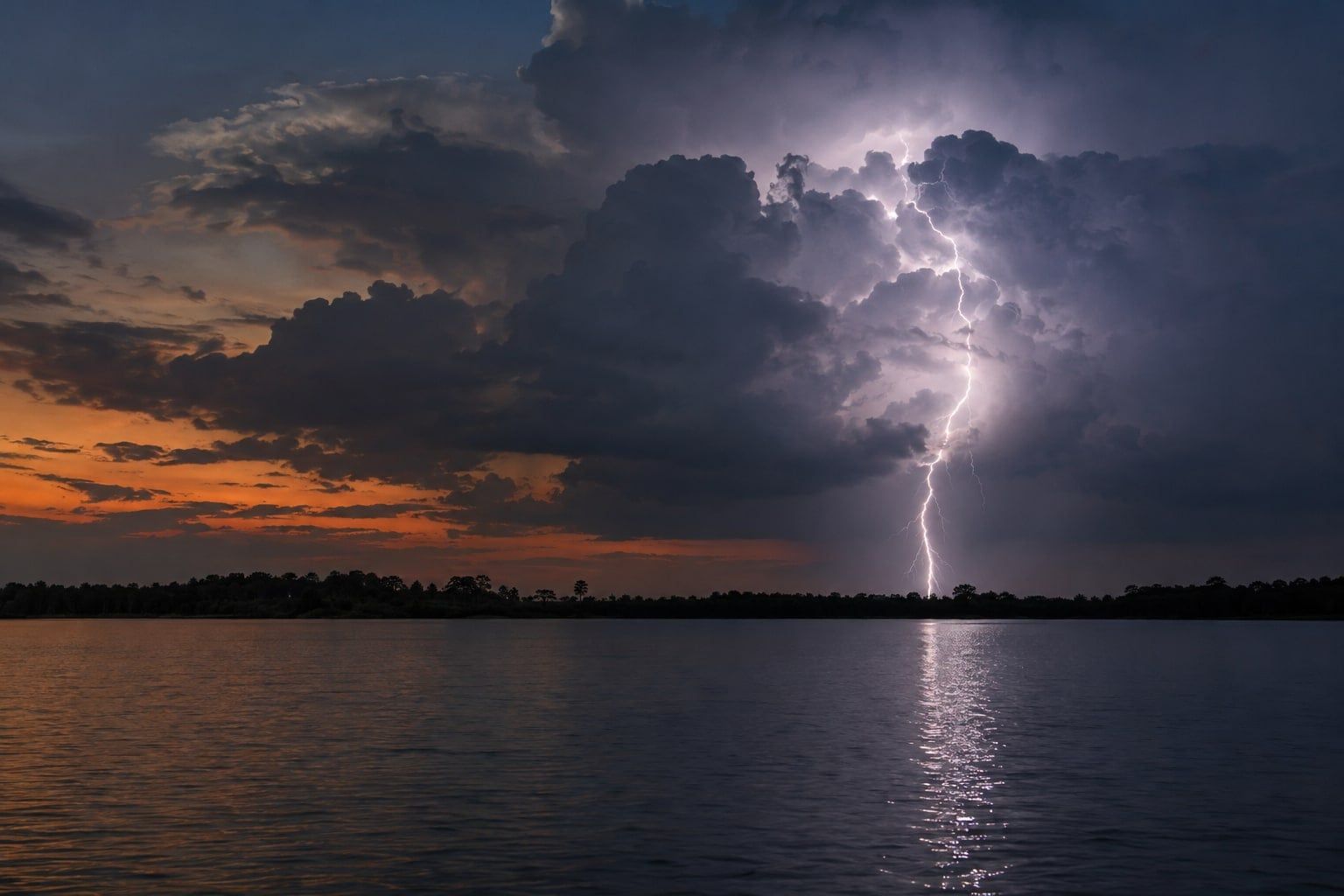
After Hurricane Ian, two volunteer gauges named for Winter Garden, 1.4 and 2.8 miles south-southeast, reported multi-day totals of 9.10 and 10.78 inches on the morning of September 30, 2022. Water in that quantity probes every joint overhead, and a thin crack in a crown or a corner of flashing that has lifted is the kind of weakness it finds. For comparison, Orlando International Airport's 1991 to 2020 normal is 51.45 inches a year, and the four months from June to September supply about 57 percent of that.
Source: NOAA ACIS, CoCoRaHS stations Winter Garden 1.4 SSE and 2.8 SSE, September 2022; NOAA NCEI 1991 to 2020 normals, Orlando International Airport
02 / 03
76. Peak gust, in knots, at Orlando International Airport in Milton
In its Hurricane Milton report the National Weather Service office in Melbourne lists a sustained wind of 49 knots and a gust of 76 knots, about 87 mph, at Orlando International Airport on October 9 and 10, 2024. The same report gives 14.83 inches at its Orlando West gauge, a few miles southeast of downtown Winter Garden, one of the ten highest totals it lists. Following wind of that strength, inspect the top of the stack first: a lid that has shifted, a bent screen, flashing peeled back at its upper edge.
Source: NWS Melbourne, Post Tropical Cyclone Report, Hurricane Milton (updated October 25, 2024)
03 / 03
4. Times the flue outlet: the free area a spark arrestor needs under the Florida code
Central Florida goes by a nickname at the National Weather Service office in Melbourne: the "Lightning Capital" of the United States. The office adds that lightning has claimed more lives in Florida, on average, than all other weather hazards put together. If a strike lands close by, have the whole chimney looked over, cap and screen included. On a masonry chimney a spark arrestor needs at least four times the flue outlet's free area (R1003.9.2), and a screen choked with soot gives that margin away.
Source: NWS Melbourne, Lightning Information Center; Florida Building Code, Residential, 8th edition (2023), R1003.9.2
Winter Garden, from the lakefront to Tildenville.
We are based in Winter Garden, a west Orange County city that grew up on the south shore of Lake Apopka. By the city's own account it was established in 1903 and incorporated in 1908, and the Census Bureau estimated 48,063 residents in July 2025. The map below draws the city limits and eight named places inside them: on the lakefront at the north, the on Plant Street in the middle of downtown, to its southwest and , where an old citrus packinghouse still stands, further west. In the northeast is on the West Orange Trail, and toward the south lie , and near the southern edge.
Not sure which side of the line your street falls on? Call (689) 303-3540 and we will tell you.
Terrain: AWS Terrain Tiles. Lakes and the city boundary: US Census Bureau TIGERweb. Place names and positions: OpenStreetMap contributors.
- Winter Garden
- Newton Park
- Garden Theatre
- Veterans Memorial Park
- Tildenville
- Chapin Station Park
- Winter Garden Village at Fowler Groves
- Braddock Park
- Black Lake Park
What Winter Garden homeowners ask.
Brief answers, each followed by its source.
How often should a flue be swept?
Burning habits, more than the calendar, set the schedule. NFPA 211 advises one inspection a year, and what that inspection finds on the flue walls settles whether a sweep follows. Fireplaces are less common in Florida than elsewhere: in 2020 the Energy Information Administration counted 77 percent of Florida homes as all-electric, the highest share in the country, and the Census Bureau's construction survey shows that half of the new single-family houses finished in the South in 2005 came with no fireplace. Occasional fires still leave a coating, and an unused flue may fill with leaves or a nest.
Source: EIA, Today in Energy, July 12, 2022; Census Bureau, Survey of Construction, fireplaces table; NFPA 211
Does a house sale or purchase call for a chimney check?
It does. NFPA 211 names a sale or transfer as the occasion for a Level 2 inspection, which goes past what you can touch to take in the attic, the crawl space and, with a camera, the flue itself. Winter Garden's housing falls into layers. In the Census Bureau's 2020 to 2024 estimates, 11,318 of 17,326 homes, roughly 65 percent, were built in 2000 or later, while 2,671, about 15 percent, predate 1980; the next house down the street may have little in common with yours.
Source: Census Bureau American Community Survey, 5-year estimates for 2020 to 2024, table B25034; NFPA 211
Where should I look after a hurricane or tropical storm?
At the top. Cap, crown and flashing meet the wind and rain before any other part. Milton sent a 76-knot gust across Orlando International Airport, and volunteer gauges named for Winter Garden filled with 9.10 and 10.78 inches during Ian. No one tallies chimney damage from Florida hurricanes, so rely on a good look from the ground, with binoculars if you own a pair, or have us visit.
Source: NWS Melbourne report on Hurricane Milton; NOAA ACIS, CoCoRaHS gauges for September 2022
Is it ever a bad month to deal with a bird or bat in the chimney?
It can be. The Migratory Bird Treaty Act covers chimney swifts, and the Fish and Wildlife Service says that taking down a nest holding eggs or young requires federal authorization first, so an occupied flue is left alone until the young have flown. The birds come back in March or April and depart in August or September. The Service recommends sweeping outside those months and asks owners not to cap a chimney that swifts use. For bats, Florida's maternity season runs from mid-April to mid-August, and excluding them then is illegal.
Source: FWS chimney swifts page and nest memorandum MBPM-2; Florida FWC bat maternity notice
Is a cap really required?
On a masonry chimney the code leaves little doubt. The top has to be a cap pitched to drain, with an overhanging edge and sealant where it meets the liner (R1003.9.1). If a spark arrestor or a rain cap is added, the open area under it must come to at least four times the flue's (R1003.9.2, R1003.9.3). Where swifts nest the timing needs thought, so check with the City of Winter Garden about what it enforces before capping.
Source: FBC Residential, 8th edition (2023), R1003.9; Fish and Wildlife Service
Mine is a metal fireplace, not brick. Does anyone need to look at it?
Yes. Metal units answer to a different set of rules. Such a unit is required to carry a listing and label and to be tested to UL 127 (R1004.1), and the same goes for the pipe above it, which must be listed and labeled (R1005.1). An unvented gas log heater may not go into one unless that fireplace was tested and listed for it (R1004.4). CSIA reminds owners that NFPA 211 expects an annual inspection of every chimney, gas-fired ones too.
Source: FBC Residential, R1004.1, R1004.4 and R1005.1; CSIA
Do you come to my part of town?
Our base is Winter Garden, in west Orange County. If you live near the city line or a little past it, ring (689) 303-3540 and we will say whether a visit is possible.
What is the way to arrange a visit?
Ring (689) 303-3540. Prefer to write? The form below is open day and night, and someone phones you back to fix a time.

What made you think of the chimney?
Describe it on the form or simply ring us. A person calls you back, and you settle on a day between you.
- 1Get in touch Ring the number or send the short form.
- 2A callback We phone you and fix a date together.
- 3Top to bottom Each of the six parts is examined in turn.
- 4Your choice We explain the findings and you decide on any work.
Request form
Open day and night